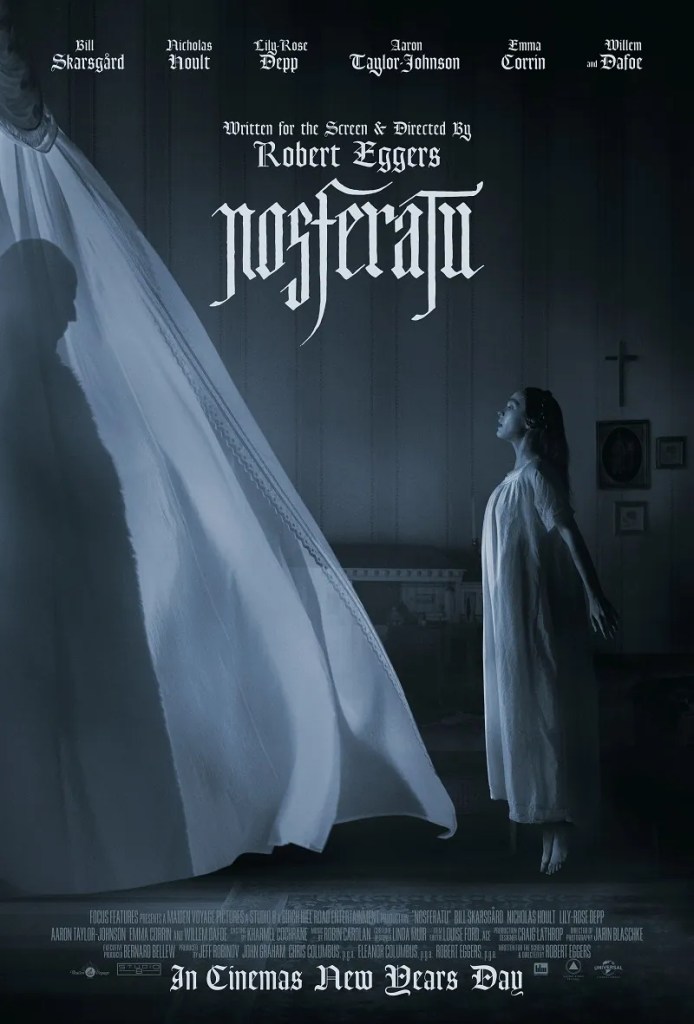
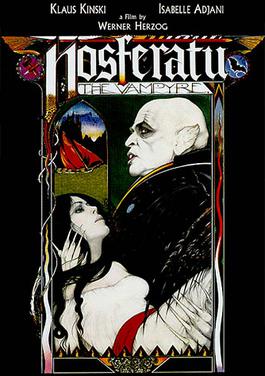
It’s been a while since we’ve discussed vampires here, and as the nights are now drawing in and the leaves are turning their autumnal colours, I wanted to go back to my roots and discuss my favourite subject. Back in January of this year, on another cold, dark, wet evening, I saw the highly anticipated Nosferatu by Robert Eggers; I then rewatched Werner Herzog’s 1979 Nosferatu the Vampyre, and it is this double-bill I will now compare and contrast. I am, however, aware that Eggers’ Nosferatu is not necessarily a straightforward adaptation or remake of Herzog’s film; it of course takes within its scope the whole of the vampire cinematic tradition, since the novel Dracula first appeared in 1897. However, I think this pairing especially illuminates the current cinematic understanding or usage of the ‘re-make’: a ‘making-perfect’ or ‘making-full’ of a poetic or lyrical earlier narrative tradition; an eradication of gaps, shadows, nuance.
Werner Herzog in his 1979 version adapts F. W. Murnau’s 1922 silent film, adding colour and sound to the bare bones of early cinema. In this example of one Gothic story, we can see that little is truly original, as cultural output constantly builds on top of previous works; I say this as a refute slightly against the ‘nothing is original anymore’ cliche; nothing ever was. Herzog, though, is a profoundly strange filmmaker, and watching the Eggers/Herzog versions back to back is a disorienting experience. Eggers applies an almost scientific fanaticism, an aesthetic fervour, to the Nosferatu subject in contrast to Herzog’s laidback dreaminess, shadowy poetry. Indeed, Herzog’s Nosferatu to the contemporary viewer is almost soap-like in its mundanity, depicting lowkey daily life in small town Germany. The actors barely act; minimal intervention seems to have been made in the settings chosen, as the towns, villages and castles all seem to be operating as if the film crew just stumbled upon them, as the weary traveller stumbles into an inn. Isabelle Adjani’s rather anachronistic thick black eyeliner does a lot of the heavy lifting in terms of adding Gothic depth to proceedings.
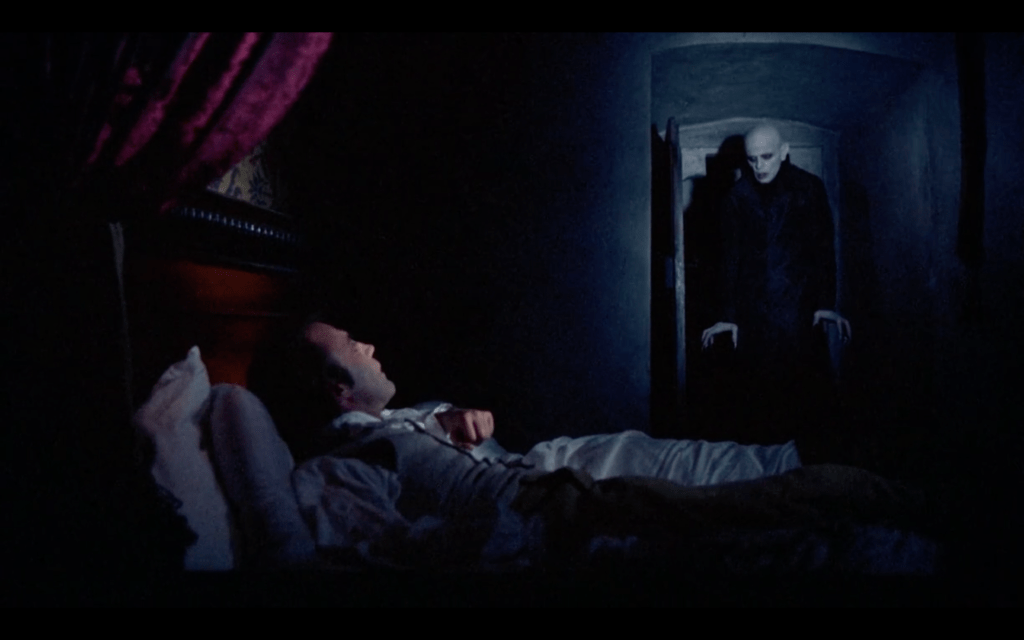
Count Orlok exists as Dracula’s shadow; a dark twin in its cultural development, an interesting splitting of legitimate/illegitimate lineages, that now, through the passage of time and expiry of copyright, becomes just another generation in the Dracula story. This excellent Artforum review describes the relationship between the two, so I won’t go into it further here. Unrelentingly unsexy and unseductive thanks to the grim little teeth of the character design, Herzog’s Count Orlok barely breathes, hardly moves, barely even covets. He seems utterly worn down by the weight of existence, weary and scarcely animated. The beauty of Mina slightly rouses him from his stupor, but he doesn’t pursue her with any vigour, and she doesn’t seem threatened by him. She only ultimately chooses to sacrifice herself to end the plague he has brought, and attempt to recover Jonathon to his previous state (which, tragically, she does not accomplish).
Eggers’ Count Orlok is a lot more threatening, characterised by a slow, deep, strongly accented voice, highly engineered in its textures that the cinema speakers revealed in all its detail, a voice as layered in its sound design as the aesthetic furnishings of the set and costumes of the rest of the film. It takes a long time for this Orlok to come into full view; he remains mostly a voice, emanating from a blurry fur-draped shape. It is the voice of the Id in psychoanalysis; he says, explicitly, “I am an appetite; nothing more.” It would have been wonderful to have him remain just this heavy-breathing, desiring voice, but perhaps that would have given him too much power. In horror films, you should never see the monster; but somehow we always do. We can’t resist looking, and it’s always a let-down. Orlok, though, should ultimately be a let-down; Kinski’s version is from the beginning. Sexuality is the subject of the narrative, not the monster itself; they represent only one facet of it.
These twin films, the 1970’s barely-there film and its high production value 2020’s remake reminds me of the Suspiria remake from a few years ago. The 2018 version was also a maximilist exercise in unrelenting detail, explanation and exposition. All that was murky, shadowy, blurry is revealed in painful high definition, no space left unfilled, fully utilising a budget probably ten times the original cost of Dario Argento and Werner Herzog’s films.
A notable filmmaking decision from Robert Eggers was his extended close-ups of the cast. The faces of Lily Rose Depp and Nicholas Hoult regularly take up the whole screen in expressive contortions of pleasure and pain. Depictions of hypnosis, sleep paralysis and parasomnia, insanity and hysteria abound, as the horror is revealed to be rooted in these experiences of not really being in control of our own bodies, instead being enslaved by desires and primal fears deepseated in our psyches.
Bram Stoker’s original Dracula novel was written in the same era as the birth of psychoanalysis and the theory of the unconscious, and I think Eggers pulls from these nascent theories to add another layer to both the ancient monster and the technology of the new industrial age. Dracula‘s plot pivots on the tension between folkloric, mythological beliefs juxtaposed with the industrial age, its new technology such as telegrams and shorthand typing. In Eggers’ version, Victorian paranoia about sexuality, control and purity combine with contemporary revelations about all that is hidden in the heart of humanity; in our own minds, there are revealed to be worlds previously unknown to us, in which parts of us can act in a way that brings chaos to our rational lives.
We are still scared of desire in 2025, though in a different way than the vampire chroniclers of 1897, 1922 and 1979; we are afraid of causing violation, distress, losing control and ruining our lives. We turn the post-Me Too movement mirror upon ourselves, question our relationships, our safety, our urges we would be more comfortable without. Female sexuality, if it has to exist, is still an endlessly problematic and paradoxical subject for film, and also for those inhabiting real bodies themselves. Hence Mina in Herzog’s Nosferatu the Vampyre is chosen by the monster through no fault of her own, she is passive and when she acts it is selflessly out of goodness; she is an object of desire but loves only purely. By contrast, Ellen in Eggers’ version has something inside of her that has sought release, called out into the darkness and awakened something that could have been left sleeping. She has some active part to play, and is conflicted about what that part of her means, if it is society or her psyche that is wrong. She struggles and shouts and writhes for almost all the film; she is never passive unless drugged and asleep. In fever and delirium she still speaks, begs, warns; of course she must be destroyed because she has the Character of the Martyr, but she does not go quietly.
It is perhaps reassuring that sexual desire continues to provide the horror at the heart of the vampire myth; sex against society, whatever that looks like. I think female sexuality, with its layers of guilt, shame, danger and pleasure, is a complex subject politically and personally and continues to elude mainstream cinema in complex new representations. As well as the Suspiria 2018 homage/remake, and the recent Frankenstein iteration by Guillermo del Toro, the upcoming Wuthering Heights version by Emerald Fennell will be an interesting chapter in this troubled series of modern remakes. Comparing the Andrea Arnold 2011 Wuthering Heights (one of my favourites WH interpretations) with its new 2026 sibling will probably be an upcoming post … in the meantime, there is something about the relentless over-writing, over-detailing of the sexy puzzles of these Gothic or vintage classics that I think speaks to not just a desire in contemporary times to express our intense feelings and dissatisfactions, but to claim these stories as ‘MINE’. Everyone wants to make a vampire film or a Wuthering Heights film; there is no satisfaction because no one agrees what makes them good.

 Sertraline Dreams