
I first came across Alice Neel’s work when my tutor Richard recommended to me the documentary Alice Neel, a film made by her grandson in 2007. This was another hit from the Glasgow School of Art library’s DVD collection. This film, which I watched in my second year at GSA at age eighteen or nineteen, ended up articulating a certain vision I had of how my own life and work might play out; I related very strongly to Neel’s steadfast unfashionableness, idiosyncratic lifestyle choices and uncompromising commitment to her practice. Since then, I have a strange feeling that I have seen Neel’s paintings in the flesh many times, but I can’t actually remember a specific exhibition in which I would have done. Perhaps I do only know them from books and films, and my familiarity is unexplained, or it’s an extension of the connection with her and her family that I felt when I watched Andrew Neel’s film.
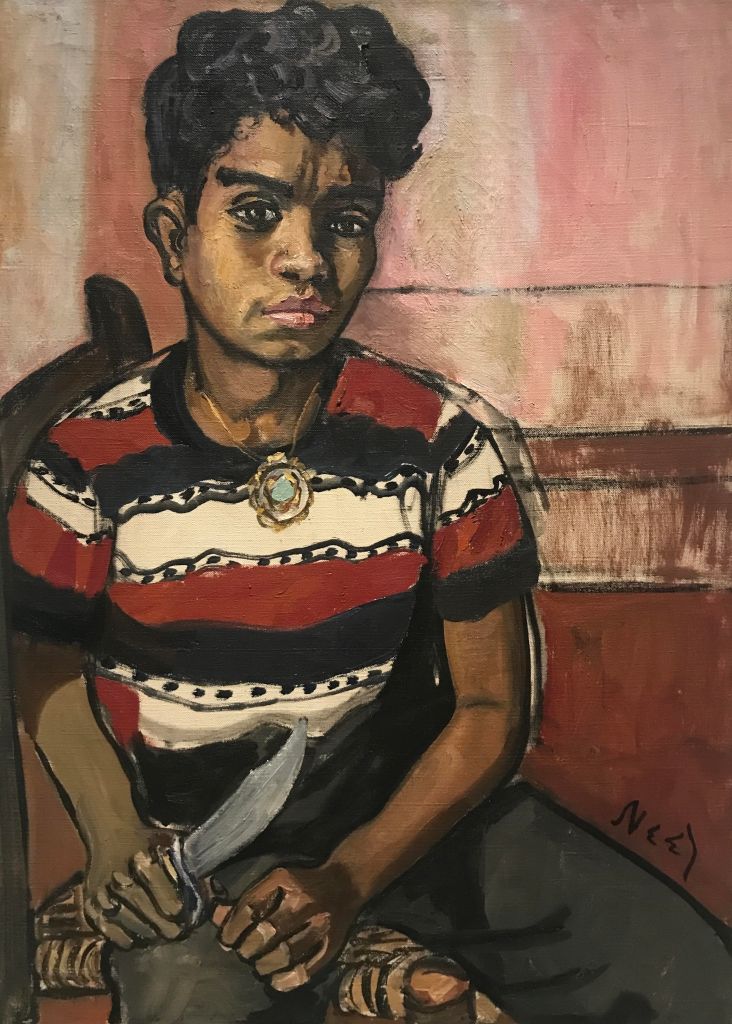
Which brings us to the recent retrospective at the Barbican, entitled Hot Off the Griddle. This may or may not have been the first time I was face to face with one of my favourite painter’s work, but the experience was slightly underwhelming – not Alice’s paintings, but the show itself. For a start, I don’t like the title … it’s from something Alice said about how she wants to paint life, hot off the griddle, but isolated of context it feels a bit housewifey, domestic, like something your granny would cook for you. Neel’s early work as included in the upper floor of the gallery was also largely unsuccessful; not assisted by the rather sparse rooms which held only a few paintings in each space. There were some industrial scenes of docklands in Brooklyn that were oddly reminiscent of L.S. Lowry, who was operating around the same time in Salford, England, and an especially upsetting many-phallused portrait of a strange Brooklynite known to be a ‘local character’.
But, once back downstairs, we get into the real tasty griddled section of the exhibition. The feeling elicited from being around all these classic Neel portraits, all these figures looking back at you, makes the viewer consider the process of creation of a portrait painting: the time spent together, artist and sitter, looking and being observed. The setting of Neel’s studio-cum-living room, consistent around the exhibition, includes recurring characters such as the stripy blue chair, or other interiors of her apartment; intruding upon this familiar space, the sitter brings their own costumes and accessories, choices that may be carefully selected, or totally random. So, once we take out the consistent studio setting, and the choices that the sitter brings, the only input Neel then offers is her style, and the expression contained only in the brushstrokes.
Ultimately, I wandered around asking myself, what is it that Neel does that makes these paintings so compelling? I came up with a few possible answers. For a start, the sitters generally have much larger heads than in real life, with often skinny, delicate hands and feet, such as in the spidery blue hands and arms of the portrait of Andy Warhol. This choice adds a psychological presence, a vulnerability and a tender brittleness to the personalities of the sitters. They also generally have wonky eyes, asymmetric features, electric blue outlines. The colours used are optically electrifying, the lines jagged and crooked, conveying restless movement and insistent individuality. But mostly, I think painting and the connection between the optic nerve, the brain and the hand results in good painting possessing a psychic presence that machine-made imagery doesn’t have. The painted person looks, in some unconscious way, like how we would experience being with that person in a real shared space.

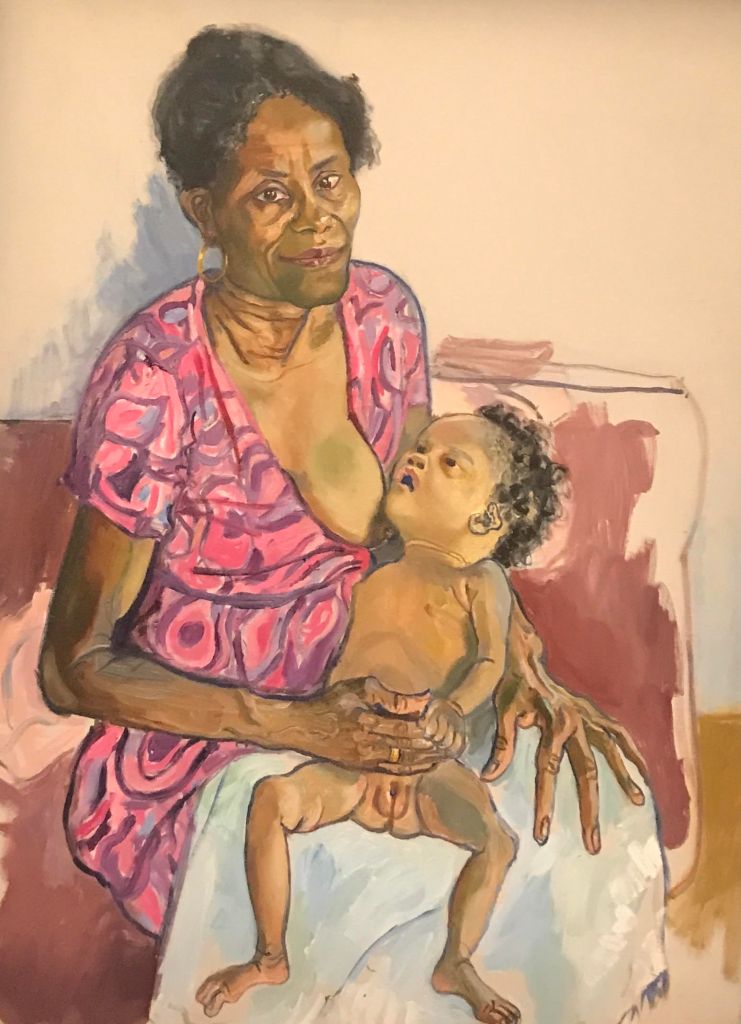
Each scene describes an emotional experience in the life of the sitter: how that person got to this point that we see here frozen in time; how life had impacted them and how they had retaliated. This may be why I find the babies in Neel’s paintings so particularly interesting, choosing them as my highlight of the show, in the same way as I did with Lynette Yiadom-Boakye’s birds and Paula Rego’s feet. In contrast to the adults who had developed into individuals who could make their own choices and shape their own lives, the babies had not had a chance to respond to life yet, and the contrast between their wide shining eyes and the faces of the adults around them was quite poignant. Neel’s babies are also actually good babies, unlike the vast majority of other paintings of children; they have the depth and complexity of human expression without any saccharine idealisation, sometimes veering towards something quite dark and desperate (like Carmen and Judy).

It wasn’t just paintings of babies that I saw as expressive of the heart of Neel’s practice, but particularly the paintings of Neel’s own babies: most prominently her sons Hartley and Richard, and later her grandson Andrew who made the documentary about Neel’s life, interviewing his father and uncle about their unconventional upbringing. Even though twentieth century female artists are far too tied into their domestic settings, in this case I think the stories of the sons adds a complicated dimension to the art and life of Alice Neel for our current understanding. Longevity is a key aspect to the legend of Neel, and her paintings of her sons as children and then young men as opposed to sitters who briefly entered and then left her life are a really important component of her oeuvre. As well as love, there is plenty of pain and darkness in the stories of the boys as they tell it; the complicated emotions are etched on their faces as they are interviewed in the documentary. There’s a story of visitors walking through the room where the boys were asleep to access the living room/studio of Neel’s apartment; this is emblematic of the chaos, uncertainty and vulnerability the boys endured for much of their childhood, themselves at times expendable in Neel’s commitment to her painting.

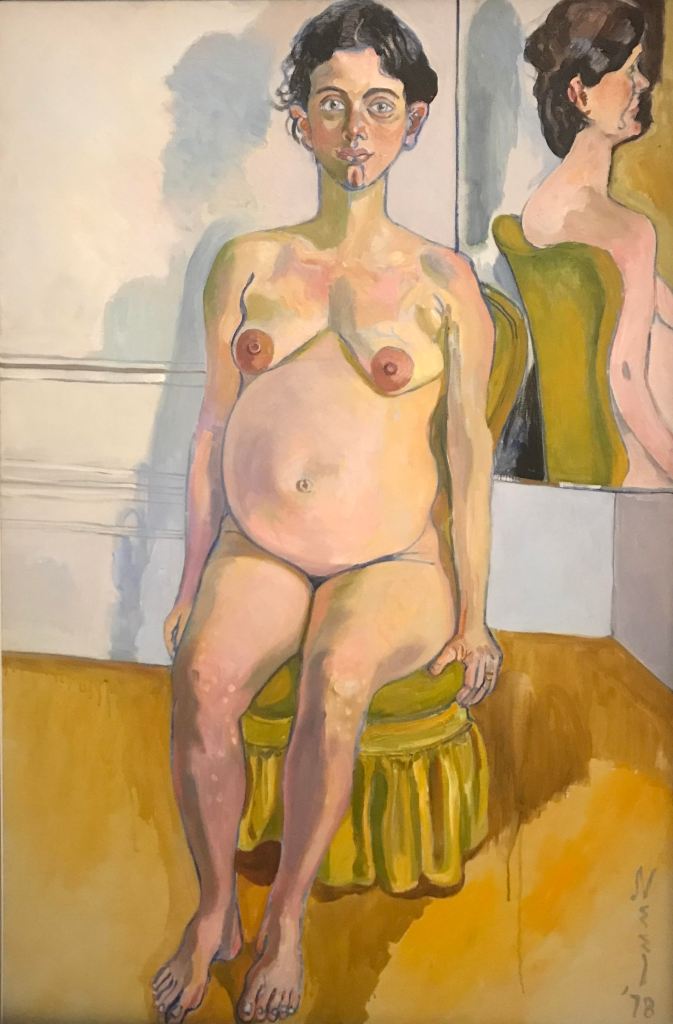
As an extension of the great babies, Neel’s portraits of pregnant women are also really interesting. I can’t think of anyone else who painted pregnancy so well apart from maybe Chantal Joffe, who was probably influenced by Neel. She has been celebrated for painting pregnant people as a kind of feminist ‘no one ever painted real pregnant bodies before’ reclamation, as an extension of her painting portraits of unorthodox subjects such as black people, Latina people, children, queer people, etc. All this is true and should be venerated of course as a lot of the power of Neel’s work is about the ability to be seen and have one’s self be validated by the artist’s eye; but in terms of the complex psychology of the pregnant experience there is something else going on.
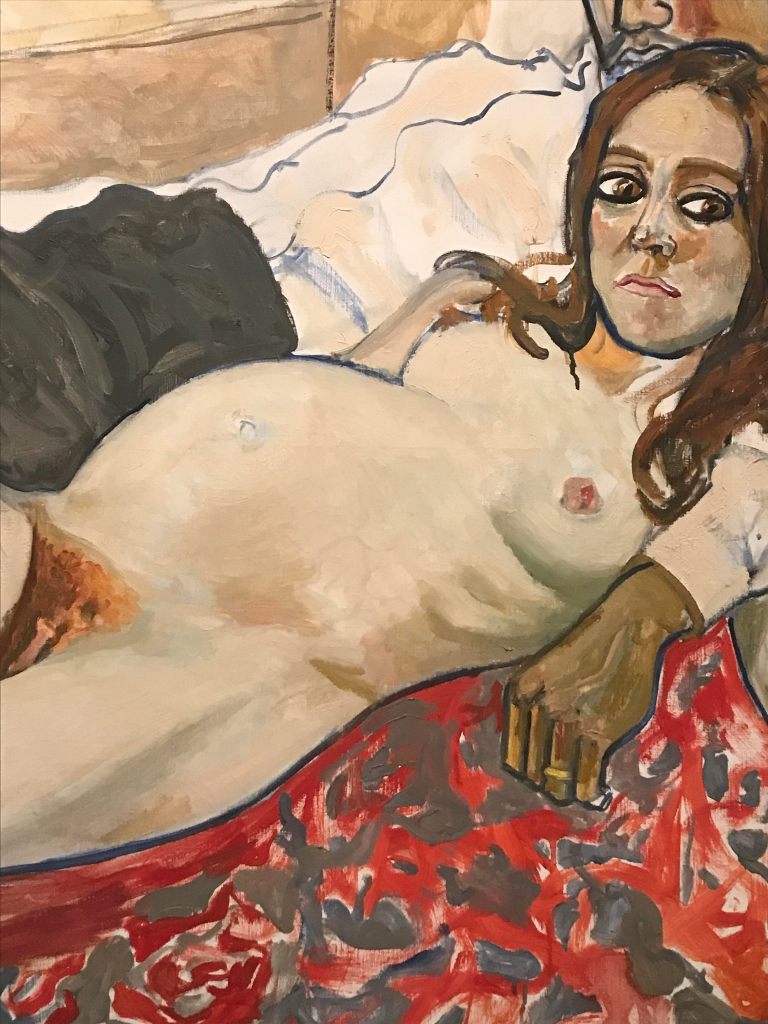
Like with the babies, there is no Virgin Mary idealisation going on, but the sitters’ experiences are also not depicted as unrelentingly grim. However, there is an interesting detachment in the eyes of the mostly naked pregnant sitters, combined with anxiety. Look at the big, black-outlined eyes of Julie; she is on the edge of panic. The eyes of Margaret, on the other hand, suggest an internal dissociation which is not serene, rather uncanny, belied in the stiffness of her seated pose. As pregnancy is rooted in the body, the body taking precedence over the mind and the individual, there is an acceptance of the intimate intrusion in these sitters, as if to say, ‘Well, I’m already sharing my body with this baby, and with my spouse, and with midwives and doctors and whoever else, so sharing myself with the eyes of this artist is not a big deal anymore.’
Alice Neel’s entire back catalogue, the rest of her impressively prolific output, forms part of each individual painting, rather like individuals making up a community. Sometimes there are other canvases stacked up in the background of the interior scene, sometimes it is simply the continuity of the stripy blue chair or the repainting of the same subject many times, such as Georgie Arce who goes from child to young man over the course of his portraits, or Julie and Algis who become a family. The years mount up, time passes, from the apartment windows we watch the city below shift and change. Over sixty years of transformation is documented in Neel’s work; at times it feels like watching a forest grow. She lived to see her own legend form. Words like persistence and perseverance are inseparable from the story of Alice Neel.
Aside from all that, the thing I am most impressed by in Neel’s work is her particular way of being outside culture but still finding a way to shape it. As a misanthropic character myself, who would love to stay in my flat painting all day without having to go out and engage with people, I really envy her solution to the problem of how to hide away but still make meaningful work, year after year, decade after decade. It’s an ingenious offer to make: the sitter doesn’t have to pay any money or give up much time or energy, but in return they become part of an ever more interesting and rich community of individuals, a member of a very cool club, a page in a living document.
 Sertraline Dreams