
“Went to see my accountants today. They suggested I buy the house on a mortgage. Makes tax easier. Also that I buy tax redemption certificates. Solves a lot of problems. They said, ‘Are you married?’ ‘No,’ I said. ‘Any prospects of you getting married in the near future?’ ‘No,’ I said. They almost advised me to find a wife and children. Makes tax easier. Solves a lot of problems.”
Wednesday 15th March 1967, The Orton Diaries (ed. John Lahr, 1978)
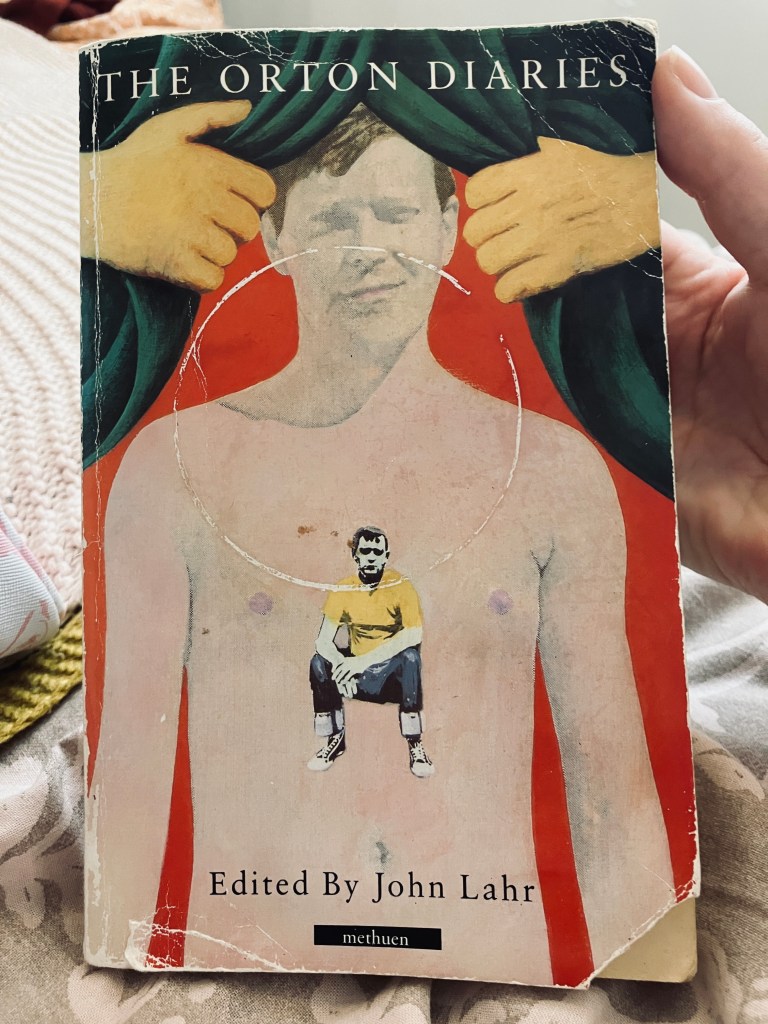
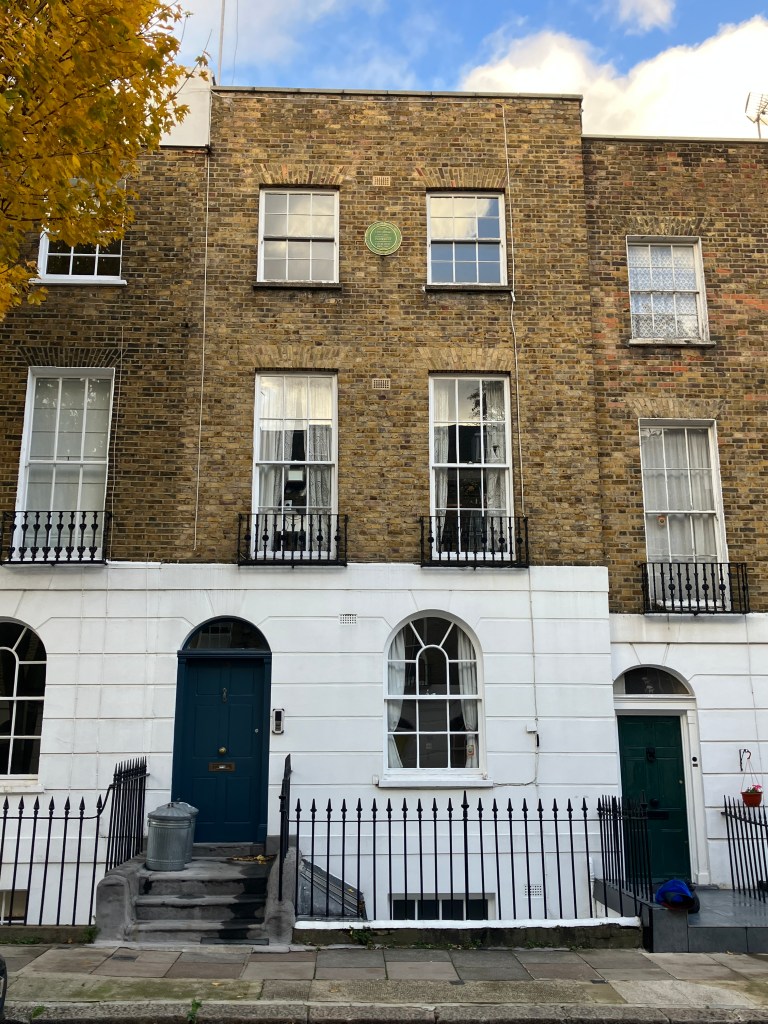
For as long as I can remember, I’ve known a little bit about Joe Orton (playwright, cottaging fanatic and library book defacer), but never really a lot. My dad was a fan, so growing up he would quote some of Orton’s lines sometimes, like ‘Cheap things suit you because you come from the gutter’. He’s a mercurial character that floated around the margins, in and out of my attention for many years; I’m pretty sure a lecturer once mentioned his and partner Halliwell’s collages of defaced library books when I was in art school. Then last year there was a reference to Orton’s diaries in the Bad Gays book I was reading; shortly after that I serendipitously came across the diaries in an Oxfam, with a mug ring stain on the cover; I love that kind of charmed encounter. The Oxfam bookshop was in Angel, incidentally, a stone’s throw from where Orton and Halliwell lived on Noel Street.
So, it’s been a bit of an Orton-fest in my life for the past month. At first, I loved the diaries. They provided such an interesting, vibrant portrait of queer Sixties London, during the years that homosexuality was tentatively being legalised. As male homosexuality makes steps towards cultural legitimacy, Orton also moves seamlessly between his working class roots and the access to privileged existence that his newfound success has brought; and by extension the lower class and upper class versions of gay male life, from picking up labourers in public toilets to hiring out luxury apartments in Tangiers or drinking champagne with camp aristocrats. He does it all with a confident, sardonic tone that is incredibly compelling, while also diligently recording the snippets of conversation old people have on the bus, the meals he has for his lunch (bacon and eggs and a cup of tea). All the minutiae of pre-internet daily life take on an almost-nostalgic cosiness from fifty years later, but these vignettes are combined with a biting wit and a blazing, pragmatic outlook. They have the urgency of someone on the top of their game riding the wave of success, but who remembers struggle, failure and deprivation very keenly.

John Lahr, who edited the diaries, is also responsible for Orton’s biography Prick Up Your Ears (1978) which was turned into a film of the same name which came out in 1987 (the same year as Withnail and I, a story also set in 1960’s London about a dysfunctional duo). Even before I knew there was a film, I looked at pictures of Joe Orton and observed that he looked exactly like Gary Oldman. Gary does an amazing job as Joe, depicting someone charming and lovable, but also you can see how you might be driven to pan his skull in with a hammer. In terms of performance, it is actually Alfred Molina as Halliwell who is phenomenal, I couldn’t take my eyes of his face; bristling with pain, eyes bulging, intense charisma on the verge of insanity.
So far, after watching the film and reading up to the latter part of the diaries, there were maybe a few dodgy references to underage boys or some mildly racist comments, but nothing that you wouldn’t expect for a document of British life from the Sixties, which mostly had a half-joking quality. Then I got to about two-thirds of the way through the diaries, to May 1967, when Orton and Halliwell set off for a holiday to Tangiers. At this point things take a very dark turn.
“[Absolem] went and sat next to Frank, who was rather annoyed and tetchy. He’s frightened of these boys I think. I heard Kenneth saying, ‘Oh Frank, we’re too middle-class to deal with them. Joe can deal with them. He comes from the gutter like they do.'”
Friday 19th May 1967, Diaries
At this point, the diaries became like reading a real-life version of Naked Lunch; Orton is pretty fixated on fucking as many Moroccan rent-boys as possible, and his fixation on their youth and exoticism is uncomfortable. Despite the sexualisation of young men and boys in North African culture that was somewhat indigenous, the networks in which the sex trade operated within layers of colonialism, Orientalist fetishisation and exploitation are inherently abusive; Orton and the other white sex tourists have an economic advantage over the Moroccan child prostitutes that means there can never be an equal, fully consenting relationship. Though, aside from the objectification, fetishisation etc, there is no real sadism or violence in the encounters Orton describes, which is a relief. Orton is far from the only prominent homosexual Western artist who took advantage of Tangier sex tourism, over several generations (Francis Bacon, Jean Genet, William Burroughs, Andre Gide, Oscar Wilde come to mind). Is it better to not read it? Does that undo the fact that it happens, indeed still happens?
I happened to rewatch Leaving Neverland: Michael Jackson and Me (Channel 4, 2019), while I was reading this part of the diaries. The patterns of abuse described in this documentary elicit similar feelings; I think after Orton’s triumphant descriptions of fucking his Moroccan boys I kind of wanted to hear a more contemporary take, exemplified in the two men talking frankly about what had happened to them as children and what it meant for the rest of their lives. Michael Jackson used his fame to access whatever child he wanted and groom their families, and his seemingly limitless fortune to pay off parents and settle court cases; similarly, Orton and Halliwell in Tangier knew they could buy any boy they saw, with no consequences. This is the same kind of very disturbing, corrupting power that should not, ever, exist.
“He thought he was really beautiful, Joe did. His real buzz was himself. When he’d leave a room, he would stand in front of a mirror – very upright – and look at himself like he thought he was very butch, very masculine. He was quite small and rather cuddly, really.”
Kenneth Cranham, actor in ‘Loot’, on Joe Orton
It is the tragic and theatrical dynamics of the Halliwell/Orton relationship that has remained relevant to a modern audience, and the diaries have, I would say, the most interesting legacy of his whole output. Orton’s plays probably would have dated quite quickly and and his fame may have faded away if he had lived; this may be unfair to say as he was only 34 when he died, but his style was rather fussy and he lacked a visionary quality that makes someone like Harold Pinter or Derek Jarman timeless; I think he was very much of his time and place. If he hadn’t have been murdered in 1967, I definitely struggle to see a world where he survived the AIDS crisis unscathed. Halliwell was inevitably going to commit suicide at some point, and if he hadn’t taken Orton with him there could be some timeline in which Orton continued his career perhaps as a columnist or critic, because as I say, his diary-writing style is so enjoyable. I’m sure he would have written an excellent autobiography as well; his love of life and all its pleasures, his defiant refusal of shame is very powerful.

The Orton/Halliwell killing led to some very complex legal wrangling, as in their wills they both left their estates to each other; so technically Orton’s estate would all have been left to Halliwell as the one who survived longer (slightly longer); then on Halliwell’s death Orton’s and Halliwell’s assets would have passed to Halliwell’s next of kin. So, it was possible that everything Joe Orton had, including the £100,000 he sold Loot for, the whole literary estate, would have ended up with his killer’s family; and, as Kenneth was an orphan and only child, this person could have been a perfect stranger. Fortunately this didn’t happen, as there are laws about murderers benefiting from inheritance; you can’t inherit from someone you’ve killed. However, I was perturbed to read that both families agreed to mix Orton’s and Halliwell’s ashes together. Of course, I am very removed from the situation, but I can kind of hear Joe’s voice from the diaries saying, ‘Fuck that! The bugger killed me with a hammer!’ As Orton had expressed that he was trying to distance himself from Halliwell, putting him in a house in Brighton and living more separately (though probably not splitting entirely) and then met a violent end at Halliwell’s hands, it seems insulting to assume he would want their ashes mixed together, Achilles and Patroclus-style. It wouldn’t be something I would want for a relative of mine who was murdered by an intimate partner.
“I walked about Brighton. I had a cup of tea at the station. I thought a lot about Prick Up Your Ears. And things in general.”
Sunday 30th July 1967, Diaries

There isn’t much trace of Joe Orton in his home city of Leicester; a cocktail bar and a square nominally named after him, though there are few signs to proclaim so. A project to erect a statue of the playwright in a prominent Leicester location eventually faltered and faded; Orton’s sister Leonie stated that it was the extended, unrepentant and graphic descriptions of sex with underage boys that eventually led to the statue project’s cancellation. I’m kind of glad Orton didn’t get a statue, even if the only reason it didn’t happen was because of how much he wrote about fucking underage prostitutes. If Margaret Thatcher and countless slave-owners and imperialists can be immortalised this way, then they have ruined statues for everyone. Orton’s story is complex and fascinating with detail of a particular time and place, and the struggles therein; his life had much to celebrate and a little to condemn. Queer history isn’t always proud; Joe had no interest in being a pillar of the community, or a martyred saint. And I think we can learn more from him as a result.
 Sertraline Dreams
I came across this page by accident and leave more enlightened than when I arrived.
I also had to reset my password as, according to the internet, I had been here before… I denied it, but they wouldn’t listen.
Anyway, great work Rosie. I hope to read you again soon.
LikeLike