Note: A version of this essay was presented in the form of a lecture entitled ‘Voicing the Voiceless’ at Conjuring Creativity conference on contemporary art and the esoteric, which took place in London on the 15th and 16th March 2025.
“‘Misereatur vestry omnipotens deus, et, dismissis peccatis vestris…’
The words issued light as a soap bubble from Father Gusewski’s pursed lips, glittered in all the colours of the rainbow, swayed hesitantly, broke loose from the hidden reed, and rose at last, mirroring windows, the altar, the Virgin, mirroring you, me, everything – and burst painlessly, struck by the bubbles of Absolution.”
Günter Grass, Cat and Mouse (1961)
I’ve chosen this passage from Günter Grass to bookend this essay, because I picked it up at the same time as collecting some thoughts about voices and voicing, and I always like to leave room for serendipity. Sometimes I think my writing style is more like putting different slightly related things in a bag as I come across them, and then displaying them one by one. However, this quote comprises a beautiful description of words as they are expressed in a particular context, expanding beyond a simple combination of breath and noise, but utilising vibrations of the flesh to construct symbols of iridescent faith and transcendence, temporal representations of the depth of cultural meaning.
The human voice exists as a void. It is not a physical organ of the body that can be dissected; it is produced from the rubbing together of flaps of flesh in the throat, that also contribute to the ability to breathe and swallow. The voice also lives in the brain, the lungs, the diaphragm; it is can be produced voluntarily or involuntarily; it is animal, as animals can scream and voice their pain and pleasure; animals can even use or at least mimic human language. However, as animal as screaming mammals we may be, we also use our voices to communicate at the highest level of cognition and culture; the voice and our language we use to connect to each other is the uncanny spirit in its flesh prison made tangible, the voice as spectral reminder of the ghost in the machine, the act of speaking as assertion of interiority, immortality and the possibility of transcendence from a cage of meat.
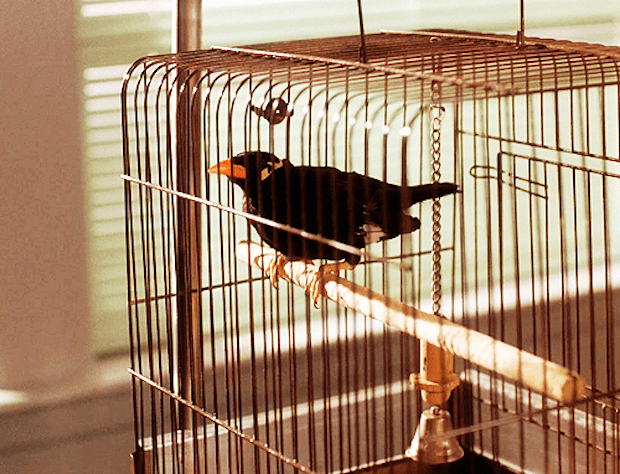
There is a scene in the first series of Twin Peaks in which the last words of Laura Palmer, the murdered 17-year-old, are chillingly recorded and played to the visibly upset sheriff and special agent investigating her death. The haunting tape recording, however, is not of Laura’s voice, but actually the voice of a myna bird called Waldo who was witness to the violence of her last hours. This scene has been playing on my mind since I started constructing this piece of writing about the voice; the animal voicing of a girl screaming adds such an uncanny darkness to the scene, the acousmêtre of Laura heard thirdhand, after being recorded by the bird and then the tape recorder. There is something about the doubly disembodied nature of Laura’s voice in this scene that, while poignant, also highlights the voice’s power when isolated. This essay considers the words and intentions of a range of female artists and speakers from the 17th century to the 21st, who use their voices to variously enact violence, grief, self-destruction and rage. These voices from contemporary art or history I have collated into three loose categories, three common acts: lament, confess, recant. Within these acts, what voices do we use to speak, other than our own?
Lament

Che si può fare: what is to be done? Sometimes all that can be done is to lament; to lament is to act, to remember, to insist and resist.
The theme of grief and lament is particularly exemplified by an artist’s film project from 2019; Helen Cammock’s Che si può fare goes on a journey across Italian musical heritage from the Baroque to contemporary jazz and blues, to portray a complex and compelling relationship between the female voice and the act of the lament; the lament, she alleges, as being a fundamental catalyst to the creation of music and art, and the act of lamenting being profoundly linked to the female experience. The lament therefore is a genre that women can exist within; a space that can provide catharsis for generations, demonstrated by Cammock as she records both 17th century arias by female Italian composers and the stories of 20th century survivors of the Italian resistance during the Second World War. The two channel film presentation exhibited at Whitechapel Gallery by turns allowed expression of cultural traumas and personal griefs through song and music; and also gently paid witness to these narratives, to allow them to live through the act of recording. If no one is there to listen, what is the use of speaking?
Over the last iteration of Glasgow International, which took place in May and June 2024, there were two projects in particular that stuck with me in terms of demonstrating certain aspects of the power of the voice, in terms of the female voice and grief, and the lament. One was the film by Alexis Kyle Mitchell entitled ‘The Treasury of Human Inheritance’, a philosophically complex and visually rich presentation of 60 minutes’ duration that both told a profoundly difficult and personal story of the artist’s family and their decimation by a hereditary disease, and a wider lensed grappling with the body and its decay, grief, spirituality and the eternal. In one scene, the artist in a voiceover describes receiving a memory stick of answerphone messages left by her recently deceased mother to a neighbour. The voice messages represent moments frozen in time of the lost person, a treasury both unbearable to engage with, in the rawness of loss, and infinitely precious as an archive of a mother’s life. Forgetting the sound of a mother’s voice is a tragedy; the messages are then played during the film, and are so evocative of a life, an identity, a breezy moment. It’s only in the last century we have been able to preserve the human voice in any shape or form and made doing so accessible to almost anyone; the film demonstrates the preciousness and precarity of the voice, and its status as the very expression of the loved person’s will and therefore identity.

Another piece from 2024’s iteration of Glasgow International was a commissioned sound piece that accompanied an installation at Tramway by Camara Taylor. Untitled (river psalm) by Ai Tung was described by the artist as a bed of riversong that flows through the space, underpinning everything. Camara Taylor’s [mouthfeel] examines Scotland’s entangled past with racial capitalism. It was a complex space that featured chocolate coins, a fountain of rum, alongside text, heavy metal boxes and lecterns fabricated in collaboration with Slag Hammers; a lot of the work foregrounded the labour of the body in mass industry, alongside references to instances of racist violence in recent Scottish history. The soundscape provided a counterpoint by creating a soft space for lament, for collecting a wider emotional response through song, in a structure referencing and deconstructing African spirituals and religious song.
Confess
I have spoken previously about confessions, towards the beginning of my ‘Oh Ill Thief’ film project; I will not repeat those points here, instead will assume the Michel Foucault assertion about confessions forming an intrinsic part of power structures first religious and then judicial are known to the reader or if not can be briefly summarised here. Confessions and their recording, their transcription, the creation of the text written down alleges it was once spoken, but by who and for what purpose? This is the question that Isobel Gowdie’s story compels me to consider. The series of four confessions she allegedly gave freely are unutterably rare and precious documents of Scottish history, Highland people, especially in its documenting of hints of a pre-Christian oral storytelling culture. In the confession, I find the interplay between the spoken and written fascinating, as the words of an illiterate woman who should have been lost to history are yet captured, to the point her own voice in its rich imagery and rhythms is somehow possible to imagine.
Confessions of witchcraft are almost unique in history as being always indisputably untrue; the way we understand the world now does not allow for flying, animal transformations or copulating with demons. This means it is tempting to paint all those who confessed to witchcraft as innocents; but I think that does a great disservice to the complex history and understanding of those cultures, those ways of seeing and experiencing the world. It is true that Michel Foucault spoke at length in his History of Sexuality volumes of how the Church bringing in routine confession structured and made policeable Western sexuality; in Gowdie’s confessions there can be read sexual desire, community tensions, experiences of famine and war, anger and resistance. These may be projections onto empty spaces based on historical contextual information, however the likelihood of these experiences is no less implausible than the magic and metamorphoses she elsewhere describes.
“Read as involved in call and response, or read as imbricated in collective or choral actions, ‘solo’ in some senses casts itself into the future as becoming ensemble even as it re-cites itself backward, answering a thousand calls.”
Rebecca Schneider, ‘Solo Solo Solo’ in After Criticism: New Responses to Art and Performance, ed. Gavin Butt (Blackwell Publishing, 2005)
Gavin Butt in his introduction to After Criticism (2005) describes Rebecca Schneider’s essay ‘Solo Solo Solo’ as foregrounding a reframing of the ‘solo’ act, movement or performance as a way in which “to see her (solo) speech act as historian as shot through with the echoes of the voices of others – of both those past and those still to come.” Schneider’s essay in part considers the uses of repetition in black cultural heritage; repetition makes capitalistic ideas of authorship, legitimacy, general gatekeeping of cultural power disintegrate and become de-centred from the artwork. I definitely hear many voices within Isobel’s, in her repetitions and allusions; when I read Schneider’s essay I found that she verbalised that uncanny something so succinctly, the quality that I previously hadn’t had words for when I’ve read the confessions over the years; the hint of an echo in a lone woman’s speech.
“The site of the event is in the witnessing, the re-telling/re-seeing, not in the ‘event itself’; and yet the ‘event itself’ becomes what is told in retelling. The mechanism of retelling is thus pitched toward eliciting a response which can stand as another generation of retelling, and function, in retelling, as yet another call. Thus the media undoes the media, resists the very mode of its manifestation, and pitches itself toward re-enactment in a variety of forms always alternative to the event itself.”
Schneider, ‘Solo Solo Solo’ in After Criticism (2005)
I asked a friend to voice Isobel Gowdie’s confessions for my film; perhaps even before she read out the words, I heard them in her voice. That is how I remember it. Now, after rehearsing and recording and re-recording, those words will always be heard through her voicing, to me. Her unique rhythm and cadence, West of Scotland accent, breath and pause. What her body gives back to the disembodied word. A re-animated corpse, the ghost in the flesh.
What words do we voice, for who and for what purposes? The overlapping circles between breath, song, voice and words; charm and curse. We can listen to disembodied voices, whose bodies are long gone, an impossibility for most of human history only recently become almost mundane; a deceased mother’s phone messages recorded forever in digital files, to be kept safe and shared with love. The act of Isobel Gowdie in speaking and confessing has a resonance no longer comprehensible to us; her voice is as ephemeral as her barely documented body, her life and world that should have disappeared to time completely, caught in doubtful text because of alleged acts of antisocial obscenity, creating an object of ink and paper inscrutable to the speaker and unnatural in its permanent captivity of words, stories and rhythms that previously had only ever been lost as soon as spoken.
Recant
The voice does not exist as a physical organ of the body; it is made of air flow, flaps of tissue vibrating, it is animal screams and also complex words and language, how we connect with but also denounce and accuse each other, and how we form and reform our own stories and identities. Through what we say, but equally what we don’t say…
The confession is interesting, but the recantation of a confession even more so.
“The difference between the two stories – rape and recantation – produced for Webb what could be called a narrative space, a place where Webb could tell a story which was identical with neither rape nor recantation, a place where her autobiography could be made public and her body introduced to the public gazes a series of pictures, larger in some sense than her life.”
Michie, ‘The Greatest Story (N)Ever Told’ (1992)
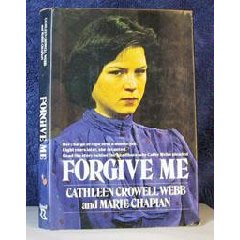
Cathleen Crowell Webb is the subject of an essay by Helen Michie entitled ‘The Greatest Story (N)Ever Told: The Spectacle of Recantation’. The essay is the second chapter of an anthology of feminist anthropology Tattoo, Torture, Mutilation, and Adornment: The Denaturalization of the Body in Culture and Text, edited by Frances E. Mascia-Lees and Patricia Sharpe (1992). Michie goes on to discuss recantations in terms of Freud’s decision to abandon his theory of childhood seduction, and his use of gendered imagery to claim authority over his female patients’ narratives and memories. However, I had never come across Webb’s story before, and I was struck by the sadness and insanity of her small life, and the spectacle Michie describes of her fame and strange attention she received following her owning of her initial lies, only once she was caught, proven wrong by DNA evidence. It all seems like a case of bad faith, even from a born-again Christian.
“I use Webb’s story, her stories, as, simultaneously, a challenge to and an embodiment of the master-narrative of rape … which, by its lack of authority, its ephemeral position as popular culture, suggests the fertility of master-narratives and brings them to bear on one scarred and culturally insignificant female body.”
Michie, ‘The Greatest Story (N)Ever Told’ (1992)
This quote from Michie, talking about the scarred and culturally insignificant female body, could be transplanted from Cathleen Webb directly onto Isobel Gowdie, who used a 17th century version of her culture’s master-narrative (the witchcraft confession) in order to speak and be heard. As we shall see, others have used master-narratives such as racist rhetoric to achieve the results they wanted, and utilising these master-narratives was more powerful than the truth or lies of the actual events themselves. The story of Cathleen Webb from the 1990’s has a strange double in the recent case of Ellie Williams. Ellie was recently released from prison after a conviction of perverting the course of justice, leading to a sentence of 8 and a half years. Webb asserted she had been raped which led to a conviction later quashed; Williams gave a series of interviews to the police as well as multiple social media posts alleging years of trafficking, grooming, rape and violence at the hands of members of the Asian community in her hometown of Barrow. The story she told mimicked very real and complex cases such as the Rochester grooming gangs; she borrowed the mistakes made in not supporting and believing those victims to confuse the investigation into her own crimes, as well as any pity for victims of grooming.
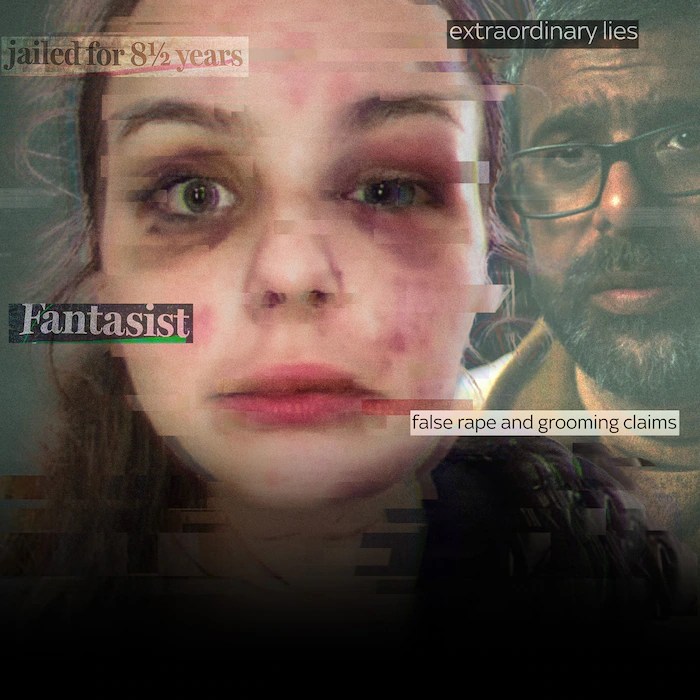
All of Williams’ allegations were found to be untrue; her words stoked racial tension in her area that led to many lives being ruined, businesses lost, acts of violence and intolerance, and innumerable other outcomes, even after her conviction for lying. She inflicted horrendous injuries to herself with an array of different implements; in another strange parallel with Webb’s case, she scratched words onto her abdomen, as supposed proof of her abuse. Webb did the same to prove her rape; the almost-words ‘HEHE’ and ‘LOV’ were said to be discernible in evidence photos taken by police. Michie in her essay on Webb calls this skin-graffiti, ‘a sinister form of self-expression, painful inscriptions on the body oddly reminiscent of some forms of feminist body art.’
“What makes conflicting stories of rape different from those that accrue around other crimes is the structuring framework of what I will call a cultural master-narrative that says that in all cases of rape women are complicitous: that rape is not a rape in the first place, but something else. The story that women lie about rape, whether we choose to believe it or not, informs all stories about rape. In undoing the individual story of her rape, Webb was telling this master-narrative; the recantation, then, was not the untelling of a story but the retelling of one infinitely more powerful, a story whose power could only be celebrated publicly and spectacularly.”
Michie, ‘The Greatest Story (N)Ever Told’ (1992)
These desperate and violent scratchings by Webb and Williams both hint at another expression of their voices, an urge to scream beyond language, the compulsion to tell and tell but unable to voice something unspeakable, something deep and dark. The more one tells, the more suspect the confession becomes, the more lies become unearthed, the more holes appear in the narrative, even when the speaker considers themselves truthful. Such is the gap between reality and perception, between listening and hearing. With the voice, there is always something missing. As Foucault has said, the more we are told the more we want to know, the more we are convinced there is something being concealed. When a lie is revealed or a confession recanted, the doubt cast on one aspect of recounting becomes a black hole into which all the narrative becomes subjected to. With Webb and Williams, whatever caused them to say what they said, we will never be satisfied with their answer. What caused their actions will always be doubted, whether they say nothing, or never stop speaking.
“‘Indulgentium, absolutionem et remissionem peccatorum vestronum …’ and the moment these new bubbles of spirit were pricked in their turn by the Amen of the seven or eight faithful, Gusewski elevated the Host and began with full-rounded lips to blow the big bubble, the bubble of bubbles. For a moment it trembled terror-stricken in the draught; then with the bright-red tip of his tongue, he sent it aloft; and it rose and rose until at length it fell and passed away, close to the second pew facing the altar of the Virgin: “Ecce agnus dei …’”
Günter Grass, Cat and Mouse (1961)
 Sertraline Dreams